Sight: How the World Gets Inside Your Head
The expanded guide to the Sight episode, following a beam of light from a lamp to your mind. Choose the age that fits your listener.
For ages 4–6
The big idea
You see because light bounces off things and lands in your eyes. Light from a lamp or the sun hits a toy, bounces off it, and flies into your eye through a little window at the front.
Inside, the light lands on the back of your eye, and here's the funny part: the picture arrives upside down. Your clever brain quietly flips it right side up, so fast you never notice.
Your eyes only catch three colors of light, red, green, and blue, but your brain mixes them into millions of colors, every shade you've ever seen.
Wonder together
- What's the most beautiful thing your eyes carried in to you today?
- How do you think your brain knows to flip the upside-down picture?
- What do you see with your eyes closed?
- Your eyes catch just three colors but you see millions. Which color is your favorite?
- If you could see one new thing, tiny germs, faraway stars, what would you pick?
Let's try it
Catch Light in a Pinhole
You'll need
- A cardboard box or tube
- Foil with a tiny pinhole, and thin paper (a screen)
- A bright window or lamp
What to do
- Make a small pinhole in foil over one end of a box, and tape thin paper over the other end as a screen.
- In a dim room, point the pinhole at a bright window or lamp.
- Look at the paper screen: a tiny image of the bright scene appears, and it's upside down.
- That's just what happens in your eye, the image lands upside down, and your brain flips it for you.
Science words
- Sight
- The sense of seeing, made from light entering your eyes.
- Light
- What bounces off things and carries their picture to your eyes.
- Eye
- The window that lets light in so you can see.
- Retina
- The screen at the back of the eye where the picture lands.
- Brain
- The part that turns light into the world you see, and flips the picture.
Spot it in real life
- Cover one eye, then the other, and notice how your view shifts a little.
- Watch colors mix on a screen up close, tiny red, green, and blue dots.
- Make a pinhole with your fingers and peek at a bright light through it.
- Close your eyes and 'see' a picture in your mind, seeing without light.
Read this one aloud, slowly
Close the two little windows of your eyes now, and let the seeing part of your brain take the night off. The remembering part takes over, replaying the good moments of today, softer and dimmer, like a gentle film winding down. There's nothing left to look at, nothing to watch for. Breathe in slow… and out… as the pictures fade, warm and quiet, and you drift into sleep.
For ages 7–10
The big idea
Vision starts with light. Rays reflect off objects and enter the eye through the pupil; the lens focuses them onto the retina at the back, where millions of light-sensitive cells turn the pattern into nerve signals. The image on the retina is upside down and reversed.
The brain does the rest, and it's most of the work. It flips and steadies the image, fills gaps (you have a blind spot you never notice), and interprets shapes, motion, and depth, constructing the seamless world you experience.
Color comes from just three types of cone cells, sensitive to roughly red, green, and blue light. From those three signals the brain mixes the millions of colors you perceive. You don't see the world directly, you see your brain's rapid, clever model of it.
Wonder together
- The retina's image is upside down, yet you see upright. What does that reveal about where 'seeing' really happens?
- You have a blind spot but never notice it. How, and why, does the brain fill it in?
- Three cone types give millions of colors. How can so few sensors produce such variety?
- You 'see' with your brain, not just your eyes. What does that mean for optical illusions?
- In dim light color fades and everything looks gray. What does that suggest about how night vision works?
Investigate it
Find Your Blind Spot
You'll need
- A sheet of paper
- A pen
- Good light
What to do
- On paper, draw a dot on the left and, about 15 cm to its right, a small cross.
- Close your right eye and stare at the cross with your left eye, holding the paper at arm's length.
- Slowly bring the paper closer while staring at the cross. At one point, the dot vanishes.
- That's your blind spot, where the optic nerve leaves the eye. Notice your brain 'fills in' the gap so you never normally see it.
Science words
- Retina
- The light-sensing screen at the back of the eye.
- Lens
- The part that focuses light onto the retina.
- Cone cells
- Retinal cells for color, in three types (red, green, blue).
- Rod cells
- Retinal cells for dim light and night vision, no color.
- Optic nerve
- The cable carrying signals to the brain; its exit is the blind spot.
- Visual cortex
- The brain region that builds sight, flipping and interpreting the image.
Spot it in real life
- Map your blind spot, then notice your brain filling it in.
- Zoom a phone screen and see the red, green, and blue subpixels that make every color.
- Try an optical illusion and feel your brain 'deciding' what you see.
- Step into dim light and watch color drain as rods take over from cones.
Printable
The Bedtime Scientist · Track & write
Vision Scientist's Log
Challenge: Map your blind spot and note how far the paper was when the dot vanished. Then test one color mix (look closely at a screen's dots). Complete the eye diagram, tracing light from the pupil to the lens to the retina, and mark the blind spot.
Journal: You see your brain's model of the world, not the world itself. Write about a time two people 'saw' the same thing completely differently, and what that taught you.
Calm science for curious kids and the grown-ups who love them.
Read this one aloud, slowly
So tonight, close the two small windows and let the seeing part of your brain rest at last. The building, flipping, filling-in, all of it can stop. The remembering part takes over now, softly replaying the day's best frames, dimmer and slower, until the reel runs quietly out. Breathe in, slow… and out, slower… and let the last images fade gently to dark, all the way into sleep.
A Silly Science Story
How the World Comes In
Pick the silliest words you can. The story stays true no matter what you choose: that's the science hiding inside the giggles. Fill in the blanks and watch it come alive.
a name the an animal blinked and wondered how seeing works. Light bounces off everything and flies into your eyes, where it lands upside down, until your clever brain flips it right side up so fast you never notice. Your eyes catch only three colors, red, green, and blue, but your brain mixes them into millions. a name looked at a a color flower, its light gently a silly action (ends in -ing) into both eyes, said a delighted "a sound," and saw a big number shades at once, then spotted a a describing word plate of a food across the room.
Word bank, to fill in by hand:
- a name
- an animal
- a color
- a silly action (ends in -ing)
- a sound
- a big number
- a describing word
- a food
Make it a Family Science Night
Tonight's experiment is even better shared. Turn it into a small event, nothing you don't already have, no pressure, just one other family and a calm hour.
The plan
- Pick a night and invite one other family. Send a text, or hand a child the placemat below to deliver.
- Set out the few things the experiment needs.
- Start the episode together, then try the experiment while it's fresh.
- Let the kids lead. Grown-ups just wonder out loud alongside them.
- End calm: dim the lights and read the bedtime tie-back aloud to everyone.
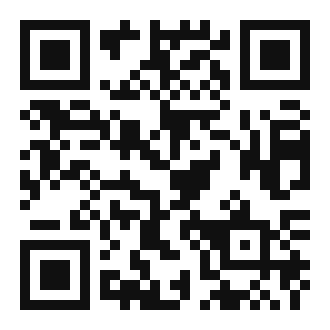 Scan to listen
Family Science Night
Tonight we're exploring
how your eyes and brain build what you see.
Scan the code to listen together, then try tonight's experiment.
The grown-up's 60 seconds
Light bounces off everything and pours through two small windows, and your brain builds the whole world from it, even flipping the upside-down image without your noticing. This episode traces a beam from lamp to mind. For a grown-up, sight is a humbling reminder that we don't see the world directly; we see our brain's swift, brilliant reconstruction of it, and at night the seeing rests while the remembering takes over.
Two small things, if you have a minute
Scan to listen anywhere
And if this one helped, even a little, leave a review, or send it to one friend who's also up past bedtime. That's how a quiet show like this one finds the next tired family.
Listen to the episode.
Pass the calm
Know another tired parent? Pass this along.
One calm bedtime deserves another.
Scan to listen · pod.link/1836539554
✂ cut out and share